Sort 83 value cards, narrow them down to the handful that guide your life, then put what they mean to you into words.
Free. Nothing you enter leaves your device. Works on a phone, a tablet, or a computer.
- In your browserThe full sort, from 83 cards to a ranked top five with your own notes. It saves in this browser.
- On paperThe card deck and a worksheet in English and Spanish, plus a youth deck in English.
- On your phoneSaved sorts you can look back on, private sync, and an app lock. Free on iPhone, iPad, and Android.
How the sort works
The three-pile sort from the Personal Values Card Sort, on your screen, with a writing step at the end. The step-by-step guide goes further, with a worked example and help for the hard parts.
Sort every card
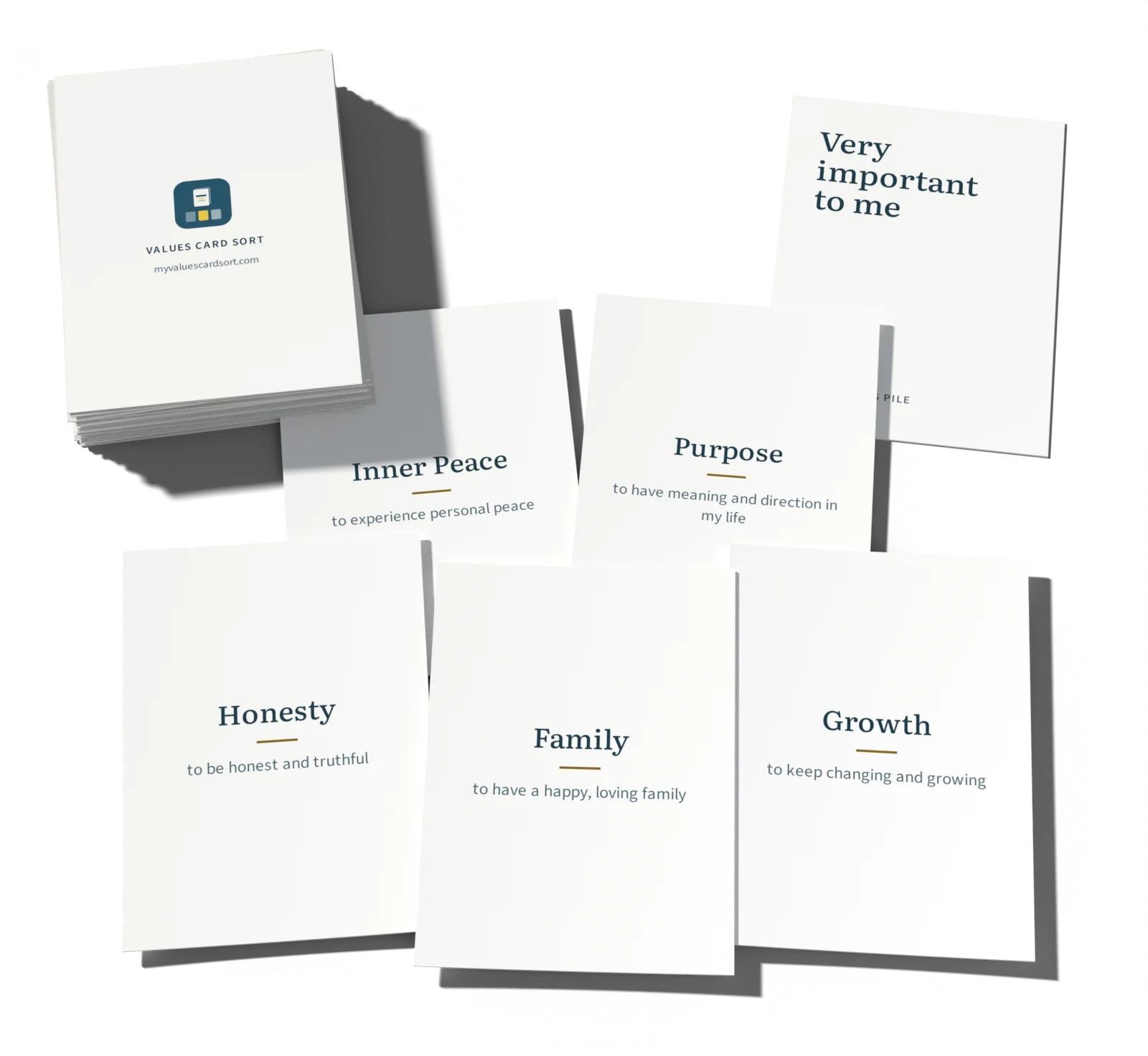
Go through all 83 value cards one at a time, placing each into Very Important to Me, Important to Me, or Not Important to Me. You can review and move cards afterward, and you can add your own values, just like the blank cards in the printed deck.
Narrow to your top 10
Look at your Very Important pile and narrow it to the ten values that feel most central. This is usually the hard part, and the useful one.
Choose and rank your top 5
From your ten, choose five and put them in order of importance. Put the one you could least do without at the top.
Reflect in writing
For each of your top five, put into words why it matters and how you’re living it right now. Your reflections appear on your printable results, so you can bring them to your next therapy session or keep them somewhere you’ll see them.
Why values matter
Values are the qualities and directions that matter most to us: the kind of person we want to be and the kind of life we want to build. Unlike goals, which can be achieved and checked off, values are more like a compass heading. Honesty, family, and creativity are never “finished.” They orient our choices, day after day.
Most of us rarely stop to name our values explicitly. We absorb expectations from family, work, and culture, and it can be hard to tell the difference between what we think should matter and what actually does. Approaches such as Motivational Interviewing (Miller & Rollnick, 2023) and Acceptance and Commitment Therapy (Hayes et al., 2006) treat that gap between values and daily living as something to work with, since noticing it is often where the motivation to change begins.
Why a card sort?
Rating values on a questionnaire is easy. Nearly everything sounds important in the abstract. Sorting cards forces trade-offs. If I could only keep one of these two, which would it be? That comparative choice invites a more honest kind of reflection, and narrowing a large deck down to a small, ranked set puts your priorities where you can see them. There’s more on where this method came from, including its roots in mid-century psychotherapy research, on the research page. If you would like to look over every value first, here is the full list of 83 values, each with the meaning printed on its card.
What people use it for
A few different reasons, in my experience. The most common is a decision already sitting in front of someone, about work or a relationship or where the hours go, and wanting something steadier to hold it against than a list of pros and cons.
The second is the gap. Reading your own top five and then thinking honestly about last week is uncomfortable. That discomfort is usually where self-chosen change starts, and change chosen that way tends to be the kind that lasts.
The third is conversation. Two people who share a vocabulary for this can open a hard topic faster, which holds in couples work and supervision as much as in individual therapy.
Values also move with the seasons of a life. Sorting again after a year, or after something large happens, usually says more than the first sort did on its own.
For therapists and helpers
Built to be used in session, assigned between sessions, or run on paper.
The Personal Values Card Sort comes out of Motivational Interviewing, where exploring values helps develop discrepancy: the felt difference between how a client is living and what they care about most (Miller & Rollnick, 2023). It also fits naturally in Acceptance and Commitment Therapy, where clarified values anchor committed action (Hayes et al., 2006), and in narrative, existential, career, and couples work.
The full therapist page covers a suggested session structure, discussion questions, how to talk about the gap between values and behavior, couples and family use, documentation suggestions, and printable materials: the card deck, a one-page recording worksheet, and client instructions in English and Spanish, plus a youth deck in English only.
Common questions
Is this a psychological test?
No. There’s no score, no norm, and no diagnosis. It’s a structured reflection exercise: a way to notice and name what matters to you. It isn’t a substitute for care from a qualified professional.
Is my data stored or shared anywhere?
Nothing you enter leaves your device. There are no accounts, and the values you sort, your rankings, and anything you write are never sent to a server. Your progress is saved only in your own browser so you can resume later. “Start over” erases it. If you print, copy, or save a session file, that copy is yours and goes only where you put it. The site uses privacy-friendly analytics that count anonymous visits, with no cookies and nothing that identifies you or reveals what you sorted. The privacy policy has the details.
Are there right or wrong answers?
No. Sort by what’s true for you right now, not by what you think should matter or what others expect. Placing a card in “Not Important to Me” isn’t a judgment of the value. It just isn’t central for you at this point in your life.
What if too many cards feel Very Important?
That’s normal, and it’s the point of the exercise. The later phases walk you through narrowing to ten and then five, and those trade-offs are where most people learn something about themselves.
Can I change my answers?
Yes, at every stage. You can undo while sorting, move any card between piles during review, go back during narrowing and ranking, and start over entirely. Values also shift over time, so it can be worth coming back to the sort after a big change, or just a year of ordinary life.
What if a value that matters to me isn’t in the deck?
Add it. While sorting or reviewing, use “Add your own value.” The printed Personal Values Card Sort deck includes blank cards for the same reason.
How long does it take?
Most people take 15 to 25 minutes. You don’t have to finish in one sitting. Progress is saved on your device, and you can also save your sort to a file and continue on another device.
Is there research behind this?
Yes. The cards come from a public-domain instrument developed at the University of New Mexico by William R. Miller, co-founder of Motivational Interviewing, and colleagues, and values work is a core part of therapy approaches with substantial evidence behind them. The research page covers the background and cites the studies.
Is there a version for children and teens?
Yes. Choose the youth deck before you start. It uses the values from Values Card Sort for Kids by Aria E. Fiat, PhD, adapted and used with her permission, and the steps and questions are written for children and teens. Younger children may like an adult reading along. Therapists can also print the youth deck, and the kids and teens page explains how to run it with a child.
Is there an app?
Yes, for iPhone and iPad and for Android. It is free, in English and Spanish, and runs the same exercise, with your past sorts kept so you can look back on them. You never need it, though. This website does the full sort on any device with a browser, and the app section below has the details.
Do I need to do this with a therapist?
No, it works well on its own. Still, the results are good material for therapy, coaching, or a conversation with a partner, and if the exercise stirs up difficult feelings, those are worth bringing to a professional.

Prefer an app?
There are native apps for iPhone, iPad, and Android: the same 83-card sort, plus saved sorts you can revisit over time, a comparison of your last two sorts, an app lock, and English and Spanish. Optional sync keeps your sorts in your own iCloud or Google Drive account. Free, with no ads and no tracking.