Values exercises you can do today
Free ways to work out what matters most to you, from a 20-minute card sort to five minutes with a pen. None of them need an account.
A value is a direction you choose for your life, like honesty, family, or creativity. Finishing a degree is a goal. Wanting to keep learning after you graduate is a value. Most of us rarely say our values out loud, and that makes it hard to tell when a busy month has pulled us away from them.
The card sort is the most thorough of these exercises, so start there if you have 20 minutes. The other three can be done on their own or after a sort.
- The values card sort 15 to 25 minutes
- Writing prompts About 10 minutes
- A weekly check-in About 5 minutes
- With a group One session
The values card sort
You sort 83 value cards into three piles by how important each one is to you, narrow your Very Important to Me pile to ten, choose and rank your top five, and write a little about each one. Rated one at a time, almost every value sounds important. Sorting makes you choose between them, and those choices show where your priorities sit right now.
The step-by-step guide walks through it with an example.
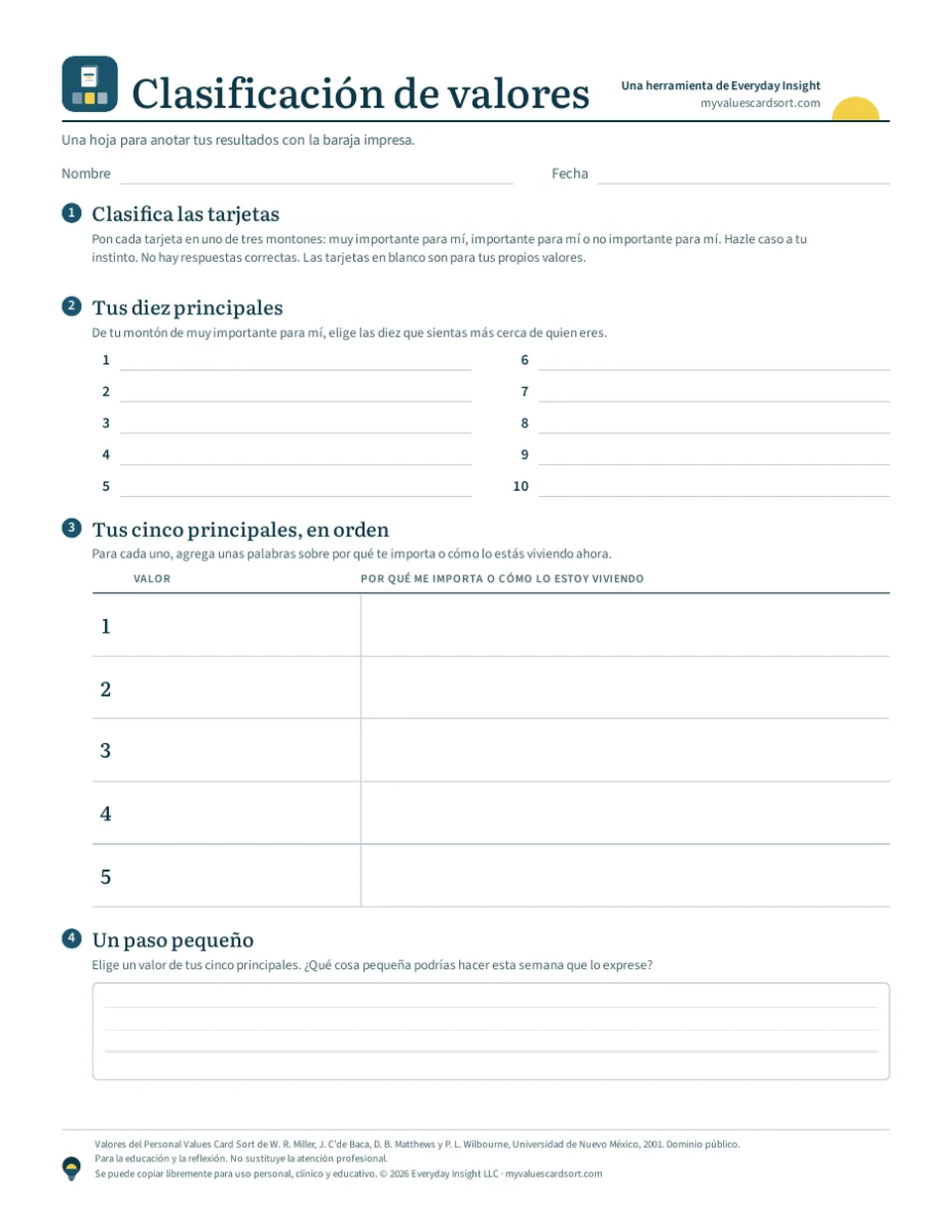
If you’d rather work on paper, sort the printed card deck and record your results on this one-page worksheet. It has room for your top ten, your top five in order with a few words on each, and one thing to do this week. The fillable version can be typed into on a computer or tablet.
- Recording worksheet Printable PDF or fillable PDF
- In Spanish printable, fillable
Writing prompts
These prompts start from memories and reactions instead of a list of words. Pick one and write for about ten minutes without stopping to edit. Then read it back and underline anything that points to something you care about, and look for the closest matches on the list of 83 values. Most people find two or three.
- A time you felt like yourself. Describe a moment when you felt most like the person you want to be. What were you doing, and who was there?
- Someone you admire. Pick someone you know or someone well known, and write about one thing in how they live or treat people that you admire. Admiration often points to a value of your own.
- A choice you’re proud of. Think of a decision that still feels right to you, especially one that cost you something. What were you standing up for?
- A hard time you got through. What mattered enough to keep you going? What did you hold on to?
- How you’d want to be described. Imagine someone who knows you well describing how you treated people and what you spent your time on. What would you hope they’d say?
Once you’ve found a value, write for a few more minutes about why it matters to you. Short writing exercises like this have been studied for decades under the name self-affirmation, and the research page summarizes what that work has found.
A weekly check-in
This takes about five minutes once a week. It keeps your values in front of you and turns them into a plan for the next seven days. It works best with your top five from the card sort.
- List your five values. Use your top five, in order.
- Rate the past week. For each value, give a number from 0 to 10 for how fully you lived it in the last seven days.
- Pick one value. Choose one you’d like to make more room for. It doesn’t have to be the lowest number.
- Make a plan. Decide what you’ll do this week, and when. If Friendship is in your five, it might be one text to a friend today.
Expect at least one low number. Most people have a value they care about a great deal and haven’t made much room for lately, and finding it is what the check-in is for. To see how your days actually line up with your values, try Activity Record, a free hourly activity and mood diary from Everyday Insight.
With a group
The card sort can also be run with a whole group, and there’s a paper version made for that. Instead of sorting cards, each member works through a printed list of all 83 values in two passes. On the first pass they check anything that matters to them at all, and on the second they star the ones that are very important. From there they narrow to ten and then five, rate from 0 to 10 how much their daily life reflects each one, and pick something to do about one of them that week.
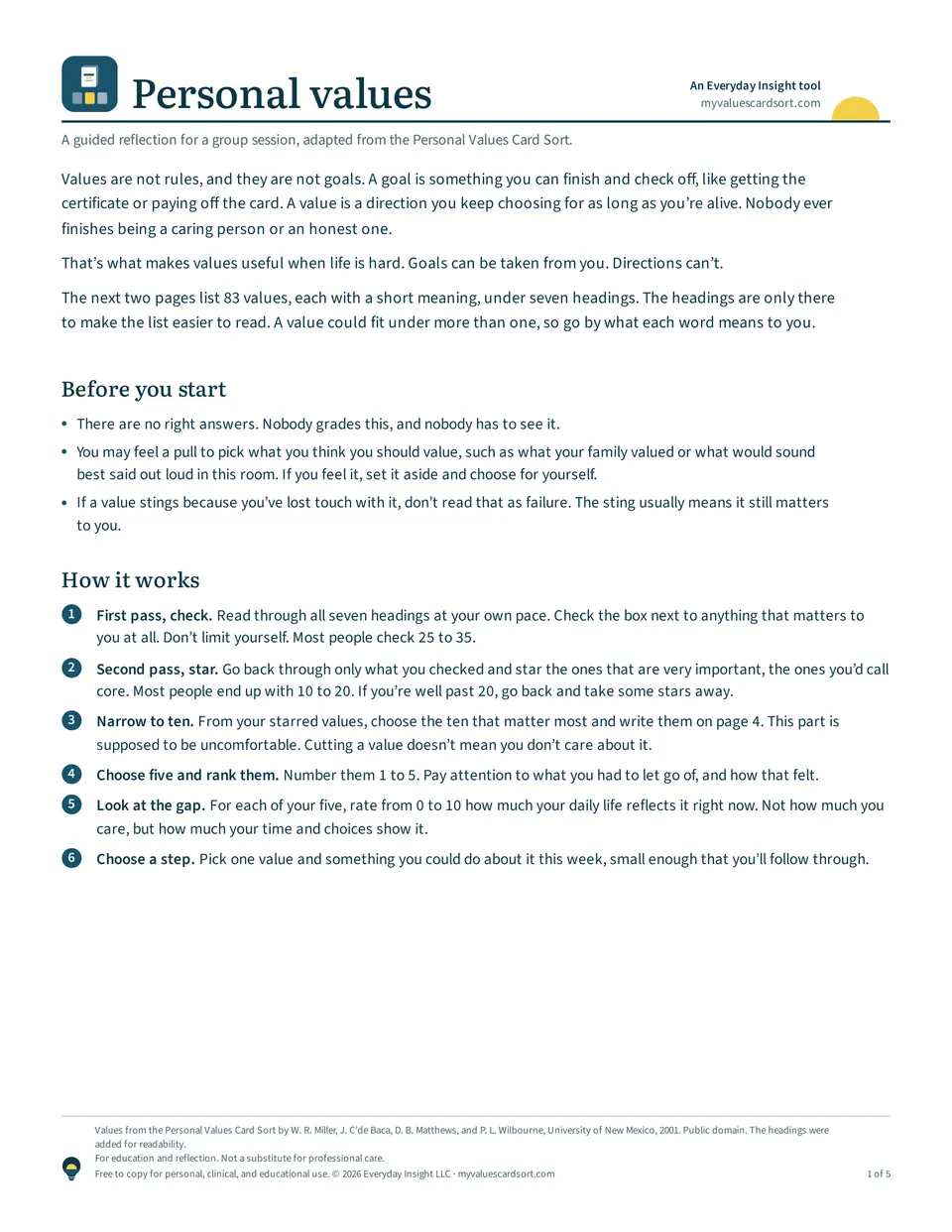
The group materials are a five-page handout for members and a six-page guide for whoever leads the group. The guide follows one 75-minute session from opening to close, drawing on Acceptance and Commitment Therapy and Motivational Interviewing, with suggested wording at each stage.
- Participant handout PDF, 5 pages
- Facilitator guide PDF, 6 pages
- In Spanish handout, guide
How a 75-minute session runs
- 8 min
- Explain how values differ from goals, and set the group norms out loud. Sharing is optional, members don’t compare lists, and nobody steps in to rescue someone who gets emotional.
- 5 min
- A short grounding exercise, such as remembering a recent hour when you felt like yourself.
- 35 min
- The sort itself, done in silence. Two passes over the list, then ten, then five, then the 0 to 10 ratings.
- 20 min
- Discussion, starting with the lightest questions.
- 7 min
- Each person names one value and one thing they’ll do this week. Anyone can pass.
Questions to start with
- What was it like to narrow it down?
- Which value surprised you by making your list?
- Were you surprised by anything you left unchecked?
- Where is your widest gap, a value you care about that your life barely reflects right now?
- What’s one thing you’re already doing, even a small thing, that lines up with one of your five?
If someone names a wide gap, hold off on reassuring them. Say back what you heard and give it a moment. That uncomfortable pause is often where people decide something needs to change.
In a classroom or workshop
For a single class period, skip the grounding exercise, go straight from the starred values to five, and keep sharing optional. Asking each person to name one value and why it matters is plenty. Students can also sort on their own phones, and nothing they sort or write leaves their device. For younger students, use the youth deck, which has fewer cards in plain words. Counselors and therapists can find more on For therapists.
Afterward
Work on one value at a time and let the rest wait. Change made in small, repeated efforts usually lasts longer than one big overhaul. Do the check-in each week for a while, and sort again in a year or after a big change to see what has moved.
None of these exercises is a test, and none of them diagnoses anything. If one of them stirs up something painful, stop for the day. A therapist or counselor can help you work through it, and so can a friend who knows how to listen.