A values card sort for kids and teens
Forty-eight cards in plain words, like “being a good friend” and “helping animals.” Kids sort them into piles, pick their top five, and talk about why those matter. It works online, on paper, or in the app, and it goes best with an adult nearby.
Many values in the adult deck, like Autonomy and Moderation, are abstract for a young child. Values Card Sort for Kids, by pediatric psychologist Aria E. Fiat, PhD, uses short, concrete phrases instead. The youth deck on this site is built from her values, adapted and used with her permission. Her values aren’t in the public domain, so please keep her credit on any printed copies.
How it differs from the adult deck
The youth deck has 48 cards instead of 83, which suits a shorter attention span. Each card is a short phrase a child would actually say, such as “spending time with family” or “being good at sports,” so there’s nothing extra to read. Kids sort into the same three piles, then pick a top five straight from the Very Important to Me pile, with no narrowing to ten. The last step asks why each value matters, out loud rather than in writing. It’s optional, and an adult can write down what the child says.
Who it’s for
The youth deck is for children and teens, with an adult nearby. For a child who isn’t reading yet, the adult reads each card aloud and the child decides where it goes. In the app, an adult runs the sort for any child under 13. Some older teens will prefer the adult deck, so let them choose. The cards are in English only.
Running it with a child
- Set it up. Explain that there are no right or wrong answers and that this isn’t a test. Online or in the app, choose the youth deck on the first screen. On paper, lay out the three pile cards and shuffle the rest. On a shared or school computer, tap “Start over” when you finish, since the website saves progress in the browser.
- Sort the cards. Let the child place every card. For younger children or early readers, read each card aloud and let them point to a pile.
- Pick the top five. From the Very Important to Me pile, the child chooses the five that matter most. If they have five or fewer, they keep them all.
- Put them in order. The one that matters most goes on top. It’s fine if the bottom of the list feels a little random.
- Talk about each one. Ask why it matters and write down their words, or let them draw instead. This part is optional.
Follow their lead. A card like “being popular/famous” or “having money or material things” belongs in the deck as much as any other, so don’t steer them away from it. Let them change their minds as they go.
When a child gets stuck
- Everything is very important. Let them put it all there. Choosing a top five will do the narrowing.
- Nothing feels important. Ask which card they would miss most if it disappeared. Some children need a few cards before they warm up.
- The answers seem silly. Keep it light. If “having fun” lands at the top, believe them.
- They seem to be picking what you want to hear. Give them some space. Move a little farther away, or let them sort on their own and tell you about it after.
- Attention runs out. Stop after the sort and finish another day.
An example
Sam is a made-up 10-year-old. His mom read the cards aloud while he sorted, and his Very Important pile ended up with 14 cards. He picked these five, put them in order, and his mom typed what he said about each one.
His top five
- Being a good friend
Why it matters
My friends make school fun, and I want them to know they can count on me.
- Spending time with family
Why it matters
I like when we play games on Sunday.
- Helping animals
Why it matters
Our dog is old now, and I help take care of her.
- Having fun
Why it matters
Because life is better when it’s fun.
- Being good at sports
Why it matters
I’m on a soccer team and I want to get better.
When his mom asked what he could do for his number one this week, Sam decided to save a seat at lunch for a new kid in his class.
Questions to ask afterward
The online sort ends with three questions. These and a few others work well in conversation:
- What is something you did this week that showed one of your top five?
- Who is someone in your life who cares about these things too?
- What is one small thing you could do for your number one this week?
- Which card was the hardest to put in a pile?
- Was there a card you wanted to put in two piles at once?
- Is there something that matters to you that wasn’t on any card?
- What do you think your best friend would pick?
Listen more than you talk. Kids often work out what they think by hearing themselves say it.
Doing it again
Children’s values change quickly. Sorting again each school year, and comparing the new five with the old printout or PDF, is a good way to see how they’ve grown.
For parents, teachers, and counselors
Parents
A sort can open a conversation that’s hard to start any other way. Try doing your own sort with the adult deck at the same time, on another device or with printed cards, then compare notes. Kids often like seeing that adults find it hard to choose too. Some families each do a sort and then share one value at dinner. If a card such as “God / my religion” or “honoring my parents or ancestors” comes up, it’s a natural opening to talk about what your family believes and where your child stands.
With teens
Teens often do better sorting on their own. Offer the sort, give them space, and let them decide what to share afterward. On the website, their sort stays on their device. Take what they share seriously, and avoid bringing it up later to make a point, which is a quick way to make them stop sharing.
Cards to follow up on
If a child puts “feeling safe and secure” or “feeling good about myself” near the top, that may just be true for them. It can also mean something is on their mind. Ask something open, like “What made that one important to you?” Then listen without assuming. If what you hear worries you, their school counselor or doctor is a good next call.
Teachers
The youth deck works with a whole class. Print a deck for each student, using the business card sheets to skip the cutting. Have students sort quietly on their own, and keep sharing optional. Asking each student to name one value and one small step is enough for a single period. The values exercises page has more on running it with a group.
School counselors and therapists
The sort fits naturally into goal setting, motivation work, and getting to know a new student or client. Some clinicians read the cards aloud and record the child’s words verbatim. For therapists has a session structure and notes on children and teens. If anything a child says during the sort raises a concern, follow your usual practice.
Three ways to do it
Online. The sort works in any browser on a phone, tablet, or computer, with nothing to install. Nothing the child picks or says is sent anywhere, and the results can be printed or saved as a PDF.
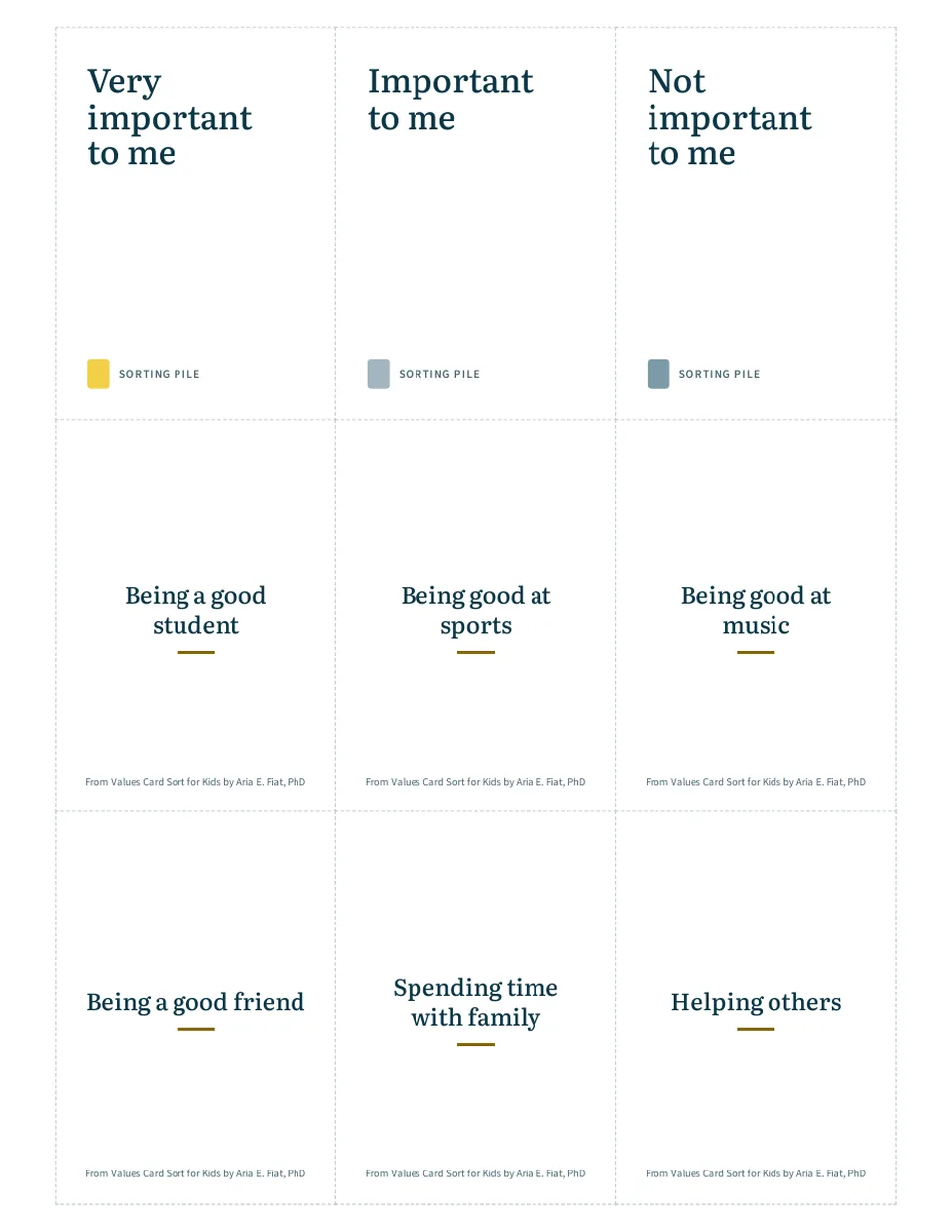
On paper. Printed cards suit younger children and kids who like to move things around while they decide. The deck includes the three sorting pile cards and blank cards for values of their own.
- Cut-out sheets Cards only or with card backs
- Business card sheets, no cutting Avery 5371 or 8371
In the app. The free Values Card Sort app for iPhone, iPad, and Android has the youth deck too. It’s meant for an adult to use with a child, and children under 13 shouldn’t use it on their own. The adult runs the app, reads each card aloud if it helps, lets the child decide each pile, and types their words in the last step. Results can be shared as a PDF without being saved on the device, which helps on a shared or work phone.